

Organizations are facing a growing level of IT complexity—hybrid environments, cloud expansion, cybersecurity threats, rising compliance requirements, and the pressure to support AI and digital transformation initiatives. For many internal teams, keeping up with this pace is difficult without additional expertise, predictable support, and scalable resources. This is why so many organizations are turning to managed IT services to operate more efficiently.
At a basic level, managed IT services provide ongoing monitoring, maintenance, security, and strategic guidance across your technology environment. But modern, fully managed IT services go much further. They give organizations a proactive partner that helps reduce risk, streamline operations, and support long-term business growth. In other words: the benefits of managed IT services extend far beyond cost savings—they help organizations operate smarter, safer, and more efficiently.
Research underscores why so many organizations are re-evaluating their use of a managed service provider and shifting to the managed services model. According to IBM’s Cost of a Data Breach Report 2024, 24% of breaches were caused by human error or misconfigurations—issues that a managed service provider can significantly reduce through continuous monitoring and standardized security practices. Furthermore, the Verizon 2024 Data Breach Investigations Report found that 68% of breaches involved external threat actors, reinforcing the need for always-on security operations that many internal teams struggle to maintain.
This guide explores the full range of managed IT services benefits—from improved security and operational efficiency to predictable budgeting and enhanced cloud performance. While we’ll take a deeper look at the most critical advantages in later sections, this introduction sets the stage for understanding the growing importance of managed IT services and why organizations of every size are adopting the managed services model to stay competitive and resilient.
Table of Contents
- Who This Guide Is Designed For
- The IT Challenges Leaders Face Today
- What Managed IT Services Really Are
- How Managed IT Services Work: Step-by-Step
- Managed IT Services vs. Alternative IT Models
- What Are the Benefits of Managed IT Services?
- How to Select the Right Managed IT Partner
- When Managed IT Services Become Necessary
- Limitations and Tradeoffs to Consider
- Why Microsoft CSP Alignment Matters
- Case Study: Measurable Outcomes From Synergy Technical's MSP
- Is a Managed Services Model Right for Your Organization?
- Frequently Asked Questions (FAQs) about Managed IT Services

Who This Guide Is Designed For
This guide is designed for leaders responsible for aligning technology with business goals—CIOs, CTOs, IT directors, CISOs, CFOs, operations managers, and anyone tasked with improving efficiency, reducing risk, and strengthening long-term resilience. If you are responsible for technology strategy, budgeting, security, or operational performance, understanding the benefits of managed IT services can help you build a more stable and scalable foundation for your organization.
Managed IT services deliver value across industries where reliability, security, and continuity are essential to day-to-day operations. This includes:
- Financial services, accounting, and CPA firms
- Regional and national banks
- Healthcare and pharmaceutical organizations
- Manufacturing
- Legal services
- Energy providers
- Nonprofits
- Retail operations
These environments often depend on strict uptime requirements, complex compliance frameworks, or distributed workforces—all of which benefit from a proactive, fully managed IT services model.
Both small-to-mid-sized businesses and large enterprises can benefit from a managed service provider. Smaller organizations often rely on an MSP to fill skill gaps, improve security posture, or modernize legacy systems. Larger organizations benefit from scalable support, expanded expertise, and the ability to reinforce internal IT teams with specialized resources. In both cases, managed IT services help support core priorities such as operational continuity, risk reduction, and long-term business resilience—critical components of any effective continuity or disaster recovery strategy.
Whether you’re evaluating the advantages of managed IT services for the first time or looking to optimize an existing partnership, this guide is built to help you understand the strategic, operational, and financial outcomes that a trusted managed service provider can deliver.

The IT Challenges Leaders Face Today
Organizations are facing an unprecedented level of technological complexity. Rising IT costs, escalating cyber threats, increasing infrastructure sprawl, and ongoing talent shortages make it difficult for internal teams to keep pace. As businesses adopt cloud services and hybrid work models, managing these systems without dedicated expertise becomes a significant challenge.
Security expectations are also growing. The IBM Cost of a Data Breach Report 2024 found that the global average cost of a data breach rose to $4.88 million, with misconfigurations, phishing, and credential compromise remaining among the top entry points for attackers. Meanwhile, the cybersecurity talent shortage complicates staffing—ISC2’s 2023 Cybersecurity Workforce Study reported a global gap of 4 million professionals, the largest shortage on record, leaving many organizations under-resourced and overextended.
Cloud adoption adds another layer of complexity. According to the Flexera 2024 State of the Cloud Report, managing cloud spend has surpassed security and expertise as the top cloud challenge. Industry analyses of the report further note that 84% of organizations identify cloud cost management as a primary concern, underscoring the difficulty of maintaining financial control as cloud environments grow more distributed and complex.
Many organizations still rely on the traditional break-fix IT model, where support is only provided when something goes wrong. While familiar, this model leads to unpredictable downtime, inconsistent costs, and a lack of strategic planning. Break-fix environments often struggle with recurring issues, aging infrastructure, and limited visibility—making it challenging to prevent outages, protect sensitive data, and scale technology to meet business needs.
Why Break-Fix IT Fails at Scale
Managed service providers (MSPs) help organizations move away from reactive, unpredictable support by introducing proactive monitoring, strategic planning, and continuous optimization. Instead of waiting for systems to fail, MSPs monitor performance, apply updates, manage security configurations, and identify risks before they impact operations. This shift reduces downtime, improves stability, and allows internal teams to focus on high-value initiatives instead of constant firefighting.
By pairing proactive management with long-term IT strategy, fully managed IT services create a more predictable and secure technology environment—one that supports modern cloud adoption, compliance requirements, digital workplace demands, and organizational growth.

What Managed IT Services Really Are
A managed services provider (MSP) is a third-party IT partner that remotely manages, monitors, and supports an organization’s technology environment. Instead of relying on reactive support or internal teams alone, an MSP delivers continuous oversight and proactive management across your systems, networks, applications, endpoints, and cloud platforms. This approach helps organizations improve reliability, reduce risk, strengthen security, and create a more predictable IT experience.
MSPs use a combination of monitoring tools, security platforms, automation, and strategic consulting to optimize your IT environment. They identify issues before they escalate, apply regular updates and patches, assist users with technical support, and help guide long-term technology planning. Whether your organization needs fully managed IT services or co-managed IT services that augment an existing IT team, MSPs provide scalable support aligned to your operational and security goals.
Fully Managed vs. Co-Managed IT
Fully managed IT services provide end-to-end management of your environment, often serving as the organization’s complete IT department. This model is ideal for businesses without internal technical staff or those that prefer predictable support and comprehensive oversight.
Co-managed IT services extend the capabilities of your internal IT team. In this model, the MSP works alongside your staff to fill skill gaps, handle specialized tasks, lead complex projects, and manage day-to-day responsibilities, including monitoring, patching, and helpdesk support. This adds flexibility and allows internal teams to focus on strategic initiatives.
The IT Capabilities Modern Organizations Require
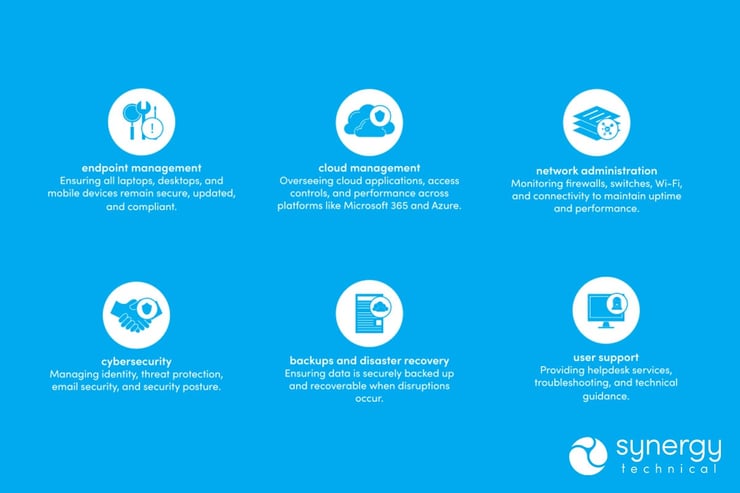
Most modern organizations depend on a core set of IT services to maintain operational continuity and security. Essential services commonly provided by MSPs include:
- Endpoint management: Ensuring all laptops, desktops, and mobile devices remain secure, updated, and compliant.
- Cloud management: Overseeing cloud applications, access controls, and performance across platforms like Microsoft 365 and Azure.
- Network administration: Monitoring firewalls, switches, Wi-Fi, and connectivity to maintain uptime and performance.
- Cybersecurity: Managing identity, threat protection, email security, and security posture.
- Backups and disaster recovery: Ensuring data is securely backed up and recoverable when disruptions occur.
- User support: Providing helpdesk services, troubleshooting, and technical guidance.
These foundational services allow organizations to operate more efficiently and reduce the risk of downtime, data loss, or security incidents.
Core Services Delivered by Managed IT Providers
Beyond foundational support, MSPs offer specialized capabilities that help organizations modernize their environments and meet evolving business needs. Together, these services create a proactive, secure, and scalable technology ecosystem. These include: proactive monitoring, patch management, help desk support, cloud migration services, disaster recovery planning, identity and access management, compliance assistance.
How Managed IT Services Apply Across Industries
MSPs tailor their services to the operational, regulatory, and security requirements of each industry. Below are examples of how managed IT services support different sectors—and where you can explore deeper, industry-specific guidance.
- Financial Services
- Financial services organizations—including banks, accounting and CPA firms, and wealth management firms—depend on strong data security, audit-ready compliance reporting, and continuous uptime. MSPs support these environments with secure cloud access controls, cybersecurity governance, identity management, and regulatory oversight designed to meet strict financial and compliance requirements.
- Discover how managed IT services support finance and banking:
- Healthcare and Pharmaceutical
- Healthcare organizations and pharmaceutical companies require HIPAA compliance, secure EMR and clinical systems, reliable remote access, and strict data integrity controls across research and patient environments. MSPs deliver continuous monitoring, compliance-aligned security, and resilient infrastructure to support both care delivery and regulated research operations.
- Discover how managed IT services support hospitals and clinics:
- Legal Services
- Law firms rely on secure document management, confidentiality controls, and dependable access to case data. MSPs support legal environments with secure workflows, data protection, and compliance-focused IT practices that safeguard sensitive client information.
- Discover how managed IT services support legal practices:
- Manufacturing and Energy
- Manufacturers and energy providers depend on network uptime, IoT device security, remote monitoring, and stable performance across distributed sites. MSPs help maintain secure, high-availability operational environments that support production systems and critical infrastructure.
- Discover how managed IT services support manufacturing operations:
- Nonprofit
- Nonprofits benefit from predictable costs, streamlined licensing, and improved visibility across programs and donor data, allowing them to focus resources on mission-driven work.
- Nonprofits benefit from predictable costs, streamlined licensing, and improved visibility across programs and donor data, allowing them to focus resources on mission-driven work.
- Retail
- Retail operations require reliable point-of-sale uptime, endpoint security, and strong protection of customer payment data. MSPs help ensure continuous availability, reduce disruptions, and safeguard sensitive information across locations and devices.
- Discover how managed IT services support retail operations:

How Managed IT Services Work: Step-by-Step
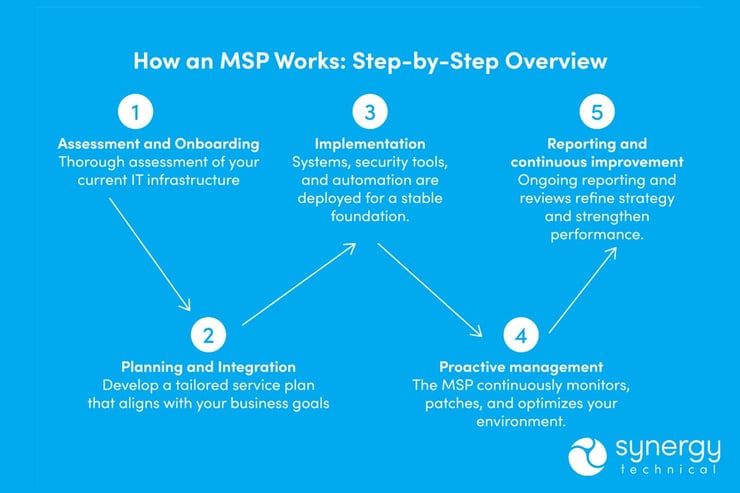
A managed service provider (MSP) delivers value through a structured, repeatable process designed to stabilize your environment, reduce risk, and support long-term growth. While each provider’s approach may vary, most managed IT services follow a similar lifecycle—from initial assessment through ongoing optimization. Understanding this process helps organizations see why the benefits of managed IT services extend beyond day-to-day support and into long-term IT maturity.
Assessment and Onboarding
Every managed services engagement begins with a thorough assessment of your current IT infrastructure. During onboarding, the MSP reviews your network, endpoints, applications, cloud services, cybersecurity controls, and existing documentation to identify strengths, gaps, and vulnerabilities. This initial discovery process establishes a baseline for future improvements and ensures the MSP understands your operational requirements, compliance needs, and business continuity priorities.
Planning and Integration
Once the assessment is complete, the MSP develops a tailored service plan that aligns with your business goals. This includes defining service-level expectations, designing support workflows, integrating monitoring tools, and outlining an improvement roadmap. Whether the organization uses fully managed IT services or a co-managed approach, this planning phase establishes how the MSP will support operations, security, and long-term scalability.
Implementation
With the roadmap in place, the MSP begins implementation. This may include setting up monitoring agents, deploying security tools, configuring backup systems, standardizing endpoints, and establishing automation for updates or alerts. During this phase, the MSP ensures your environment is prepared for proactive oversight—laying the groundwork for consistent performance, stronger security, and improved reliability.
Proactive Management
After implementation, the MSP transitions into ongoing management. This stage is where organizations experience many of the core managed IT services benefits, including continuous monitoring, automated patching, vulnerability mitigation, helpdesk support, and optimization of cloud, network, and endpoint systems. Instead of waiting for problems to occur, the MSP identifies risks early, reduces downtime, and keeps the environment secure and up-to-date.
Reporting and Continuous Improvement
Managed IT services are not static. MSPs regularly review performance metrics, security posture, incident trends, and system health to help organizations make informed decisions. Through routine reporting, strategic reviews, and technology planning sessions, MSPs help organizations refine their IT strategy, strengthen compliance, and continually enhance operational efficiency. This ongoing improvement cycle is a primary reason businesses are evaluating the benefits of using a managed service provider, often prioritizing MSPs over break-fix or ad-hoc support models.

Managed IT Services vs. Alternative IT Models
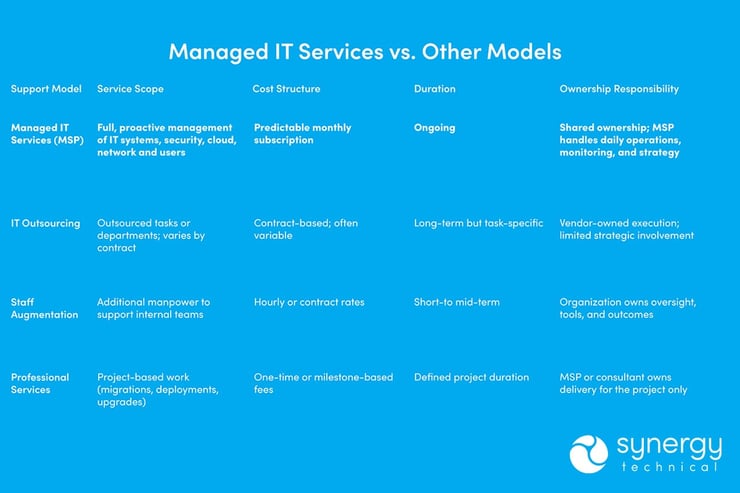
As organizations evaluate technology support options, it’s common to compare managed IT services to other delivery models—IT outsourcing, staff augmentation, and professional services. While these models may appear similar, each offers a different level of support, cost structure, and strategic value. Understanding these differences helps leaders see why the benefits of managed IT services often extend beyond those of other approaches.
Managed IT Services vs. IT Outsourcing
Traditional IT outsourcing typically focuses on offloading specific tasks or entire departments to an external vendor. While effective for cost reduction or specialized functions, outsourcing often lacks long-term strategy and proactive oversight.
A managed service provider (MSP), on the other hand, acts as a strategic partner. MSPs integrate with your business, continually monitor your environment, and help guide long-term technology planning. Rather than simply taking over a function, MSPs provide ongoing optimization, security, and modernization aligned to your business goals.
Managed Services vs. Staff Augmentation
Staff augmentation adds temporary or contract personnel to an internal IT team. This model is helpful for short-term projects or for filling a skill gap, but it does not provide the tools, automation, monitoring, or strategic direction that come with managed IT services.
In contrast, MSPs provide comprehensive coverage, including 24/7 monitoring, patching, user support, and cybersecurity—capabilities that individual contractors typically don’t deliver. MSPs serve as an extension of your existing team while providing the structure, processes, and predictability that staff augmentation cannot.
Managed Services vs. Professional Services
Professional services are project-based engagements—such as cloud migrations, system upgrades, or architecture planning. These are valuable when organizations need specialized expertise for a specific initiative.
Managed IT services differ by offering ongoing, proactive support rather than one-time help. MSPs continuously maintain, monitor, and improve your environment, ensuring long-term reliability and reduced risk. Professional services may be part of an MSP’s offering, but they do not replace the continuous lifecycle management provided through managed IT services.

What Are the Benefits of Managed IT Services?
The benefits of managed IT services extend far beyond cost savings—they help organizations operate more efficiently, strengthen security, reduce downtime, and support long-term digital transformation.
- Improved IT budgeting and cost control
- One of the most well-known benefits of managed IT services is predictable budgeting. MSP pricing models are structured around a monthly operational cost, allowing organizations to move away from unpredictable break/fix expenses. This reduces large capital expenditures and helps avoid the significant costs associated with hiring, training, and retaining internal IT staff.
Fully managed IT services offer a low upfront investment and a more affordable alternative to staffing an in-house IT department—especially for small and mid-sized organizations that require enterprise-grade expertise without the enterprise-level price tag. For many leaders, evaluating why to use a managed service provider, cost predictability is a significant advantage.
- One of the most well-known benefits of managed IT services is predictable budgeting. MSP pricing models are structured around a monthly operational cost, allowing organizations to move away from unpredictable break/fix expenses. This reduces large capital expenditures and helps avoid the significant costs associated with hiring, training, and retaining internal IT staff.
- Access to certified IT experts
- With an MSP, organizations gain on-demand access to a wide range of certified IT specialists. These experts bring experience across cloud platforms, cybersecurity frameworks, compliance requirements, end-user support, and infrastructure design. MSP teams also maintain continuous training on Microsoft 365, Azure, security technologies, and industry best practices—giving customers access to knowledge that is often costly or difficult to maintain internally. The result is access to a broad talent pool, 24/7 support coverage, and specialized expertise that ensures your environment is managed consistently and effectively.
- With an MSP, organizations gain on-demand access to a wide range of certified IT specialists. These experts bring experience across cloud platforms, cybersecurity frameworks, compliance requirements, end-user support, and infrastructure design. MSP teams also maintain continuous training on Microsoft 365, Azure, security technologies, and industry best practices—giving customers access to knowledge that is often costly or difficult to maintain internally. The result is access to a broad talent pool, 24/7 support coverage, and specialized expertise that ensures your environment is managed consistently and effectively.
- Strengthened data protection and cybersecurity
- Cybersecurity is one of the most critical advantages of managed IT services. MSPs provide proactive threat detection, identity and access management, email protection, endpoint monitoring, and vulnerability mitigation. This helps organizations reduce risk, protect sensitive data, and maintain compliance with industry regulations.
For businesses in regulated industries—such as finance, healthcare, legal, and energy—MSPs deliver enterprise-grade protection that smaller teams often cannot implement alone. This level of proactive defense is a key reason organizations seek out the benefits of a managed service provider.
- Cybersecurity is one of the most critical advantages of managed IT services. MSPs provide proactive threat detection, identity and access management, email protection, endpoint monitoring, and vulnerability mitigation. This helps organizations reduce risk, protect sensitive data, and maintain compliance with industry regulations.
- Faster response times and a single point of contact
- Instead of waiting for issues to escalate, MSPs offer streamlined support through well-defined SLAs, dedicated helpdesk teams, and account managers who fully understand your environment. This improves response times and provides a single point of contact for all IT concerns, eliminating confusion and accelerating resolution. For many organizations, this is one of the most practical managed services benefits—fewer delays, less downtime, and more consistent support.
- Instead of waiting for issues to escalate, MSPs offer streamlined support through well-defined SLAs, dedicated helpdesk teams, and account managers who fully understand your environment. This improves response times and provides a single point of contact for all IT concerns, eliminating confusion and accelerating resolution. For many organizations, this is one of the most practical managed services benefits—fewer delays, less downtime, and more consistent support.
- Minimized downtime and improved network stability
- With 24/7 monitoring and proactive maintenance, MSPs detect issues early and prevent disruptions before they affect users. This reduces unplanned downtime, improves network performance, and helps organizations avoid costly outages. This proactive approach is central to the advantages of managed IT services and helps organizations maintain business continuity even as demands grow.
- With 24/7 monitoring and proactive maintenance, MSPs detect issues early and prevent disruptions before they affect users. This reduces unplanned downtime, improves network performance, and helps organizations avoid costly outages. This proactive approach is central to the advantages of managed IT services and helps organizations maintain business continuity even as demands grow.
- Maximized cloud capabilities
- Modern businesses depend on cloud services—and fully managed IT services help them use these platforms more effectively. MSPs optimize Microsoft 365, Azure, and hybrid cloud environments by managing identity, security, performance, and governance. They also help organizations enable secure remote and hybrid work environments, streamline cloud adoption, and ensure services are configured for stability and scalability.
- Modern businesses depend on cloud services—and fully managed IT services help them use these platforms more effectively. MSPs optimize Microsoft 365, Azure, and hybrid cloud environments by managing identity, security, performance, and governance. They also help organizations enable secure remote and hybrid work environments, streamline cloud adoption, and ensure services are configured for stability and scalability.
- Scalable IT solutions
- Scalability is one of the most practical benefits of IT managed services. MSPs allow organizations to scale IT resources up or down as needed—ideal for growing companies, seasonal operations, or businesses experiencing rapid change. Instead of rebuilding internal staffing or infrastructure, organizations can adjust their services to meet demand.This flexibility supports long-term digital transformation and helps avoid unnecessary costs or delays.
- Scalability is one of the most practical benefits of IT managed services. MSPs allow organizations to scale IT resources up or down as needed—ideal for growing companies, seasonal operations, or businesses experiencing rapid change. Instead of rebuilding internal staffing or infrastructure, organizations can adjust their services to meet demand.This flexibility supports long-term digital transformation and helps avoid unnecessary costs or delays.
- IT vendor and licensing management
- MSPs simplify vendor coordination by consolidating support, licensing, renewals, and procurement through a single partner. This gives organizations better visibility into usage, reduces billing complexity, and ensures licensing remains compliant and optimized. For many leaders, this is one of the most underrated benefits of managed services, especially when managing multiple cloud subscriptions, Microsoft licensing, or third-party applications.
- MSPs simplify vendor coordination by consolidating support, licensing, renewals, and procurement through a single partner. This gives organizations better visibility into usage, reduces billing complexity, and ensures licensing remains compliant and optimized. For many leaders, this is one of the most underrated benefits of managed services, especially when managing multiple cloud subscriptions, Microsoft licensing, or third-party applications.
- Increased transparency and security awareness
- Through regular reporting, strategic reviews, and employee cybersecurity training, MSPs improve visibility into system health, threat activity, compliance risks, and user behavior. This builds a culture of security awareness and helps employees understand their role in protecting the organization. This enhanced transparency is a key managed service provider benefit for industries that depend on audit readiness and risk management.
- Through regular reporting, strategic reviews, and employee cybersecurity training, MSPs improve visibility into system health, threat activity, compliance risks, and user behavior. This builds a culture of security awareness and helps employees understand their role in protecting the organization. This enhanced transparency is a key managed service provider benefit for industries that depend on audit readiness and risk management.
- Boosted employee productivity
- Optimized systems, stable networks, secure access, and responsive support all contribute to better user efficiency. With fewer disruptions and faster resolutions, employees can stay focused and productive. When paired with modern cloud applications and secure collaboration tools, managed IT services directly benefit organizational performance.
- Optimized systems, stable networks, secure access, and responsive support all contribute to better user efficiency. With fewer disruptions and faster resolutions, employees can stay focused and productive. When paired with modern cloud applications and secure collaboration tools, managed IT services directly benefit organizational performance.
- Faster adoption of new technology
- MSPs help organizations design and execute technology roadmaps—modernizing systems, migrating workloads to the cloud, deploying new collaboration tools, and improving infrastructure. This accelerates digital transformation and helps organizations keep pace with changing business demands. This forward-looking guidance is one of the most strategic advantages of the managed services model.
- MSPs help organizations design and execute technology roadmaps—modernizing systems, migrating workloads to the cloud, deploying new collaboration tools, and improving infrastructure. This accelerates digital transformation and helps organizations keep pace with changing business demands. This forward-looking guidance is one of the most strategic advantages of the managed services model.
- Focus on core business objectives
- With an MSP managing daily IT operations, internal teams gain time to focus on innovation, growth, customer service, and strategic initiatives. This is one of the biggest reasons organizations evaluate why they choose managed IT services—they enable staff to do their best work without being pulled into constant troubleshooting.
Ultimately, MSPs offer peace of mind. Leaders know their environment is secure, stable, optimized, and managed by professionals who understand both technology and business priorities.

How to Select the Right Managed IT Partner
Selecting the right managed service provider is one of the most critical decisions an organization can make. The ideal MSP should not only deliver the benefits of managed IT services—such as cost savings, stronger security, and improved performance—but should also serve as a long-term strategic partner. As you evaluate potential providers, keep the following criteria in mind.
Qualifications and Experience
A strong MSP will demonstrate deep experience across cloud, security, and modern workplace technologies. Look for Microsoft partner designations, advanced certifications, and technical specializations that validate the provider’s expertise. Awards, published case studies, and industry-specific success stories can also offer insight into how well the MSP supports organizations with similar needs. These qualifications help ensure your provider can deliver the full spectrum of managed IT services benefits across your environment.
Flexibility to Tailor Service Models
Every organization operates differently, which is why flexibility is a key advantage of the managed services model. The right MSP should offer customizable service packages—whether you need fully managed IT services, co-managed support, or a hybrid approach. Tailored service helps ensure alignment with your operational requirements, internal team structure, compliance standards, and long-term goals.
Pricing Options that Fit Your Budget
Transparent pricing is essential when evaluating your choice of managed service provider. MSPs typically offer models such as tiered services, à la carte add-ons, per-user pricing, or per-device billing. The best providers clearly outline what’s included, how costs scale as your business grows, and how their services reduce or eliminate hidden expenses—such as unplanned break/fix costs or infrastructure inefficiencies. Look for pricing that aligns with your budget while delivering measurable value.
Availability and Service-Level Agreements (SLAs)
Around-the-clock availability is one of the most important benefits of a managed service provider, especially for organizations that rely on high uptime or support distributed teams. Evaluate whether the MSP offers 24/7 monitoring, guaranteed response times, clear SLAs, and coverage that meets your organization’s operational hours and risk profile. Reliable availability ensures that critical issues are addressed quickly and proactively.
Customer Satisfaction and Reputation
Client testimonials, reviews, and references can provide valuable insight into how an MSP performs in real-world scenarios. Look for indicators of trust, responsiveness, professionalism, and long-term customer retention. Strong customer satisfaction signals that the MSP delivers consistent support and meaningful results—two of the most important managed services benefits organizations look for.
Long-Term Partnership and Business Alignment
The right MSP is more than a vendor—they are a partner invested in your long-term success. Look for providers who offer strategic guidance, roadmap planning, and technology recommendations that support future growth. A strong MSP should scale with your organization, adapt to new requirements, and help you modernize securely as your environment evolves. This long-term alignment is key to realizing the full advantages of managed IT services over time.

When Managed IT Services Become Necessary
Organizations often begin considering managed IT services when daily technology challenges start outpacing internal resources. While every environment is unique, several clear signals indicate it may be time to move beyond a break-fix model.
Frequent downtime is one of the strongest warning signs. If outages disrupt operations or recurring issues keep returning, the environment has likely outgrown reactive support. Break-fix models make downtime unpredictable and costly, while the benefits of managed IT services—such as proactive monitoring and early detection—offer far greater stability.
An overworked or understaffed IT team is another indicator. When internal teams are overwhelmed with tickets, updates, and security tasks, essential maintenance is delayed, and vulnerabilities go unnoticed. A managed service provider helps fill these gaps by delivering specialized expertise and consistent coverage.
Recurring problems, missed updates, aging infrastructure, or slow response times also signal that the current approach isn’t keeping pace. As systems become more complicated to manage, both operational and cybersecurity risks increase. Rising security concerns, audit failures, or compliance challenges are often the final push that leads organizations to evaluate why they should use a managed service provider.
To determine whether your business is ready for MSP support, assess your IT health:
- Downtime Frequency
- Ticket volume
- Staffing capacity
- Patching cadence
- Security posture
- Cloud or network complexity
If IT challenges are slowing productivity—or if your team spends more time fixing issues than improving operations—the advantages of managed IT services can provide immediate, measurable relief. When technology becomes a barrier instead of an enabler, it’s a clear sign that the time for managed IT services has arrived.

Limitations and Tradeoffs to Consider
While the benefits of managed IT services are significant, it’s important to understand the potential downsides as well. Like any partnership, success depends on alignment, communication, and the provider’s understanding of your business. Being aware of these challenges helps organizations set better expectations and choose an MSP that fits their needs.
One common concern is reduced direct control over systems. Because an MSP manages monitoring, patching, and daily support, internal teams may feel removed from some aspects of operations. Clear visibility, documentation, and shared governance help address this challenge, while ensuring IT decisions remain collaborative, transparent, and aligned with business priorities.
Another consideration is provider dependency. Relying on an MSP for critical services means that the provider’s responsiveness, expertise, and consistency become central to your daily operations. This makes trust and accountability essential—reinforcing the importance of choosing a partner with strong service-level agreements, proven processes, and transparent communication.
Misalignment with internal processes is also possible if the MSP does not fully understand your workflows, compliance requirements, or business goals. Successful partnerships rely on regular check-ins, open communication, and a willingness to adapt support models over time.
There are also scenarios where organizations may need to look for a new MSP. Signs include poor communication, lack of transparency, slow response times, missed SLAs, or limited understanding of your environment. If the provider cannot scale with your business, provide strategic guidance, or deliver the promised managed services benefits, it may be time to re-evaluate the partnership. By understanding both the advantages and challenges, organizations can make more informed decisions and select an MSP that aligns with their expectations, culture, and long-term goals.

Why Microsoft CSP Alignment Matters
Choosing the right managed service provider is essential—but partnering with a Microsoft Cloud Solutions Partner (CSP) delivers an additional level of expertise, alignment, and long-term strategic value. Because most organizations rely on Microsoft 365, Azure, and Microsoft security tools to support daily operations, a CSP brings specialized insight into the technologies that power the business. As a Microsoft CSP, Synergy Technical delivers managed IT services that combine deep Microsoft expertise with proactive, long-term IT management—allowing organizations to align technology decisions with business outcomes.
A Microsoft CSP provides deep expertise across cloud modernization, identity, licensing, and digital workplace environments. This includes:
- Cloud migration planning and execution
- Licensing optimization and cost control
- Identity and access management across Microsoft 365 and Azure
- Security configuration, compliance alignment, and risk reduction
- Strategic consulting to support long-term digital transformation
These capabilities ensure your Microsoft ecosystem is deployed, secured, and optimized correctly from day one.
Partnering with a CSP also creates seamless integration across Microsoft platforms. Instead of treating each tool as a standalone product, a CSP helps align your Microsoft 365, Azure, and security investments into one cohesive environment. This includes:
- Secure hybrid and remote work enablement
- Centralized identity through Entra ID
- Threat protection and compliance through Microsoft Security solutions
- Modern collaboration experiences powered by Teams, SharePoint, and OneDrive
- Optimized Azure resources for scalability and cost efficiency
Combined with managed IT services, this creates a secure, stable, and future-ready foundation for your entire organization.
What sets Microsoft CSPs apart is their ability to combine technical expertise with long-term advisory support. Rather than simply maintaining your environment, CSPs help organizations develop and execute technology roadmaps, modernization plans, and cloud strategies that support ongoing growth. From mid-sized to enterprise, we provide tailored Microsoft solutions to support long-term success. This ensures that your managed IT services provider isn’t just solving today’s issues—but is actively helping your organization prepare for tomorrow’s challenges.

Case Study: Measurable Outcomes From Synergy Technical's MSP
- Manufacturing
- A manufacturing company with 50 employees faced challenges managing its expanding and complex IT systems, leading to frequent downtime, security breaches, and outdated technology. Synergy Technical's managed IT services team assessed the IT environment, identified gaps, and developed a customized strategy. They upgraded infrastructure, strengthened cybersecurity, implemented automated backup and disaster recovery, managed software and hardware, and provided 24/7 monitoring and maintenance.
As a result, the company experienced less downtime, higher productivity, stronger cybersecurity, reliable data backup and recovery, and more predictable IT costs. Staff could focus on strategic planning instead of troubleshooting. Partnering with Synergy Technical enabled the company to resolve IT challenges and establish a secure, efficient, and innovative IT environment that supports continued business growth.
- A manufacturing company with 50 employees faced challenges managing its expanding and complex IT systems, leading to frequent downtime, security breaches, and outdated technology. Synergy Technical's managed IT services team assessed the IT environment, identified gaps, and developed a customized strategy. They upgraded infrastructure, strengthened cybersecurity, implemented automated backup and disaster recovery, managed software and hardware, and provided 24/7 monitoring and maintenance.
- Commercial real estate
- A company manages large commercial properties and needed to improve IT reliability, reduce downtime, and secure financial data. Our managed services centralized IT support, implemented advanced monitoring and compliance tools, and significantly enhanced security.
As a result, the firm experienced much faster response times to issues, reduced IT-related interruptions, and improved protection of sensitive financial data. These improvements drove more efficient operations, consistently high tenant satisfaction, and a notable reduction in disruptions across all properties.
- A company manages large commercial properties and needed to improve IT reliability, reduce downtime, and secure financial data. Our managed services centralized IT support, implemented advanced monitoring and compliance tools, and significantly enhanced security.
- Healthcare and social services
- A regional provider needed to maintain regulatory compliance, system uptime, and data security for patient care. Managed services delivered proactive monitoring, comprehensive compliance support, and tailored security measures.
This resulted in near-continuous system uptime, robust regulatory adherence, and more reliable access to patient records. The improved reliability and security directly supported better patient care and ensured ongoing trust with clients and regulators.
- A regional provider needed to maintain regulatory compliance, system uptime, and data security for patient care. Managed services delivered proactive monitoring, comprehensive compliance support, and tailored security measures.

Is a Managed Services Model Right for Your Organization?
The benefits of managed IT services extend far beyond day-to-day troubleshooting. By shifting from reactive IT to a proactive, strategic model, organizations can strengthen cybersecurity, reduce downtime, improve performance, and build a scalable foundation for the future. Whether you’re modernizing your cloud environment, improving compliance, or seeking greater cost control, the right managed services partner can turn technology into a true business advantage.
That value is amplified when you work with a Microsoft Cloud Solutions Partner. With deep expertise across Microsoft 365, Azure, identity, security, and licensing, a CSP helps ensure your environment is optimized, secure, and aligned with long-term business goals. As a Microsoft Cloud Solutions Partner, Synergy Technical delivers tailored Microsoft solutions for mid-sized and enterprise organizations—helping future-proof IT strategies through secure, scalable, and well-governed cloud environments.
Discover how our managed IT services can simplify operations, reduce risk, and support long-term growth.
Or connect with our team directly: https://www.synergy-technical.com/contact
Frequently Asked Questions (FAQs) About Managed IT Services
- What are the components of managed services?
- Managed services typically include proactive monitoring, helpdesk support, patch management, cybersecurity, cloud management, backup and disaster recovery, endpoint management, and ongoing IT strategy. Together, these components create a comprehensive, proactive approach to managing technology rather than reacting to issues after they occur.
- What is the managed services model in IT?
- The managed services model replaces reactive, break-fix support with ongoing, proactive IT management. Organizations pay a predictable recurring fee for defined services, allowing an MSP to continuously monitor systems, address issues before they escalate, and provide long-term strategic guidance. This model improves reliability, security, and cost predictability.
- What are the key benefits of using a managed IT services provider (MSP)?
- The benefits of managed IT services include predictable IT costs, improved cybersecurity, reduced downtime, faster issue resolution, access to certified IT experts, and scalable support. MSPs also help organizations modernize cloud environments, maintain compliance, and align IT strategy with business objectives.
- How does the managed services model reduce IT costs?
- Managed services reduce IT costs by replacing unpredictable break-fix expenses with a consistent monthly model. MSPs help lower capital expenditures, optimize cloud and licensing spend, prevent costly outages, and reduce the need to hire and retain large internal IT teams—making IT spending more controlled and transparent.
- How do managed IT services improve security?
- Managed services improve security through continuous monitoring, standardized security configurations, identity and access management, proactive threat detection, and regular patching. By reducing misconfigurations and closing security gaps early, MSPs help organizations lower the risk of breaches and maintain compliance with industry regulations.
- How do managed services support business continuity?
- Managed services support business continuity by ensuring systems are monitored, data is regularly backed up, and recovery processes are tested and maintained. MSPs help minimize downtime during disruptions and enable faster recovery from incidents such as cyberattacks, system failures, or data loss.
- Can a managed services model support remote or hybrid workforces?
- Yes. Managed services are well-suited for remote and hybrid environments. MSPs manage secure access, cloud collaboration tools, endpoint security, identity controls, and performance monitoring—ensuring employees can work productively and securely from any location.
- How do managed services improve operational efficiency?
- Managed services improve operational efficiency by reducing downtime, streamlining IT processes, automating routine tasks, and providing faster issue resolution. With an MSP handling day-to-day IT management, internal teams can focus on strategic initiatives instead of constant troubleshooting—resulting in better productivity and smoother operations.
Comments