

Every week, I talk with customers who are excited — and a little overwhelmed — about AI. They’ve seen the demos, read the headlines, and heard that AI is going to “change everything." And it will. But not the way most people think.
The real impact of AI doesn’t start with technology. It starts with people — how they work, what slows them down, and what they need to be more effective. That’s why your AI strategy shouldn’t begin with tools. It should begin with conversations.
Read more about AI strategy:
Start by Listening to Your People
When we help organizations shape their AI strategy, we don’t start with a product pitch — we start by asking questions:
- What tasks are taking too much time?
- What information do people struggle to find?
- What processes feel outdated or repetitive?
The answers are rarely technical. They’re human. And that’s exactly where AI adds value — by removing friction in how people work every day.
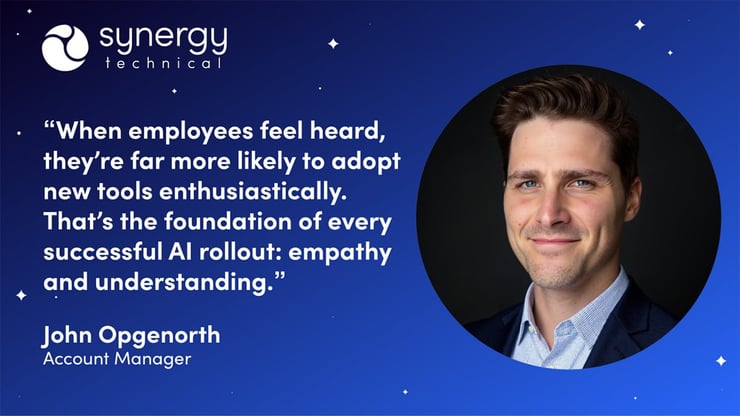
When employees feel heard, they’re far more likely to adopt new tools enthusiastically. That’s the foundation of every successful AI rollout: empathy and understanding.
Don’t Deploy AI — Integrate It
I see a lot of companies try to “deploy AI” as if it’s a single project. But AI isn’t a tool you install and move on from. It’s a capability that should weave into the fabric of your existing environment.
That means starting where your people already are — in Microsoft 365. Copilot isn’t something new to learn; it’s something that enhances the apps your team uses every day.
When you integrate AI where people already work, adoption becomes natural. They start to see it as an assistant, not a disruption.
Find the Everyday Wins
The biggest successes I’ve seen aren’t always the flashiest. They’re the small, practical wins that make someone’s job easier:
- A sales rep saving an hour a day by summarizing customer emails with Copilot.
- A project manager creating meeting summaries and next steps automatically.
- A finance lead using AI to reconcile reports faster and spot anomalies.
These small wins build momentum. They prove value, increase confidence, and create internal champions who help AI adoption spread organically.

AI Strategy Is a Change Management Strategy
Technology is the easy part. Change management is the hard part.
If you don’t have a plan for how to communicate, train, and support your employees through AI adoption, the best technology in the world won’t matter.
An AI strategy should include:
- Clear expectations for how AI will be used.
- Transparent communication about what data is (and isn’t) shared.
- Training tailored to each department or role.
When people understand the “why” behind AI, resistance turns into curiosity — and curiosity becomes innovation.
The Bottom Line
AI isn’t replacing people — it’s empowering them. But only if you build your strategy around the people who make your business run.
Start with their needs.
Choose tools that fit naturally into their work.
Celebrate small wins.
And support them through the change.
Because when you focus on people first, technology follows — and that’s when AI truly starts driving transformation.
By John Opgenorth, Account Manager, Synergy Technical.
We are not just consultants––we are practitioners. As users of various AI tools within our organization, personal lives, and client environments, we bring first-hand expertise to guide your AI journey. Don't miss out on the opportunity to drive efficiency, productivity, and innovation. Contact us today to unlock the full potential of AI for your organization.
Comments